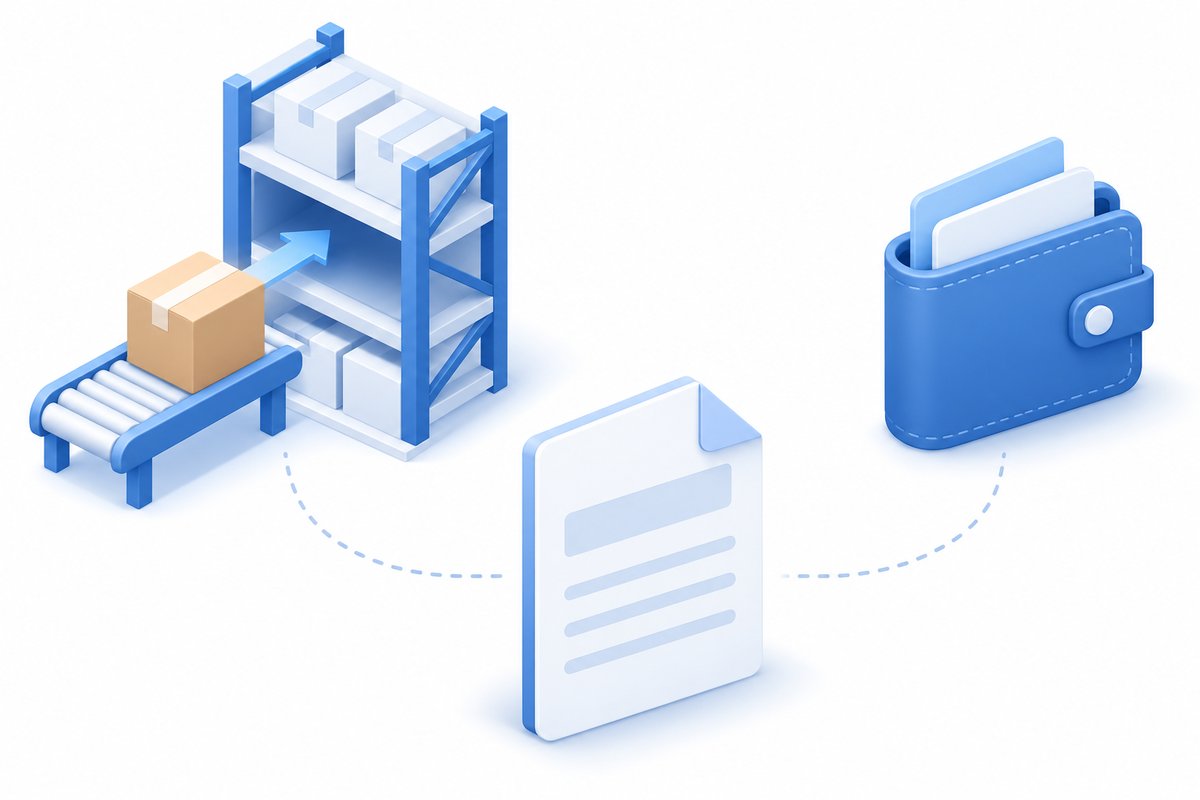

A financial document is not proof of physical receipt
Accounting has issued a customer credit note, but ERP stock has not increased. Should someone manually adjust inventory? First check the return workflow. Reducing a receivable, moving goods and refunding cash are separate events. Some systems link them, but the actual automation and completed states must be verified. A credit-note number alone does not establish that everything is finished.
Odoo 19 documentation illustrates a Reverse Transfer for returning goods separately from a Credit Note for the financial side. The warehouse validates the return when the goods arrive. This explains what to check, not a claim that every ERP uses identical buttons or accounting entries. Foreign software documentation is not a substitute for Thai tax-document requirements.
Reconcile three states with linked references
Start with the original delivery, approved return and evidence of goods actually received. Match product codes, units, quantities, lots or serials and locations. A request to return everything is not evidence that everything arrived. For partial receipts or items awaiting inspection, use the company’s appropriate status and holding location so damaged goods are not treated as available for sale.
Then check which invoice the credit note references, whether it covers an agreed portion or the full amount, and whether it is posted. Finally, distinguish a cash refund from credit applied to an outstanding balance. Do not record cash leaving merely to complete a status when no refund occurred. Link the three parts through traceable references and assign ownership of anything still pending.
Hypothetical example: three requested, two received
Suppose 10 units were delivered and the customer requests a return of 3. Only 2 arrive, and one of those needs inspection. Track requested, physically received and resale-approved quantities separately. The credit amount must follow verified agreed terms; requested and received quantities must not automatically substitute for each other. These are workflow assumptions, not a ruling on return rights or tax treatment.
If a credit note exists without a stock move, inspect configuration, the originating workflow and who must validate the receipt before creating another entry. For integrations, determine whether the original event is pending or already has a reference. A temporary inventory adjustment followed by completion of the original return can add stock twice. Resolve the cause while preserving an auditable history.
Let warehouse and finance verify closure together
Before rollout, test full and partial returns, inspection failures and credits offset against balances in an authorized environment. Compare warehouse quantities, receivables and cash records with the evidence. Inventory-cost postings can depend on the software version and valuation method, so finance should check them separately. Correct quantities do not automatically prove correct valuation or accounting.
Close the case when each event has evidence and a reviewer, with pending items explicitly left open. Escalate disputed terms or tax conditions to the responsible specialist before changing entries. For Chawinnix accounting-system and ERP services, bring sample documents with unnecessary information removed and a responsibility map, so stock, accounting and payments can be linked through verifiable checkpoints.